

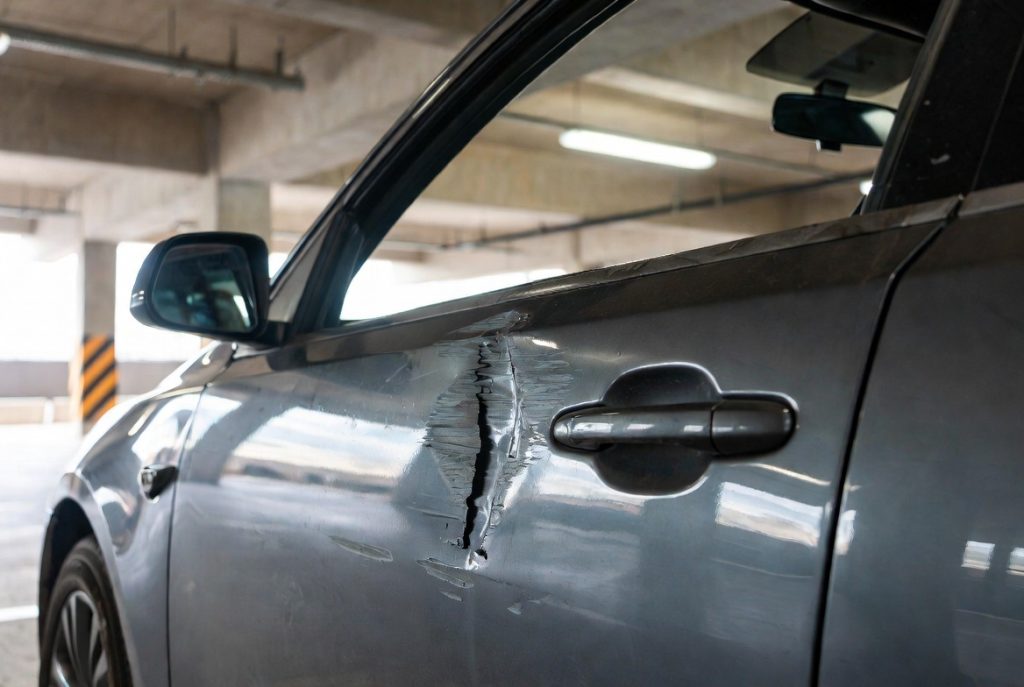
A $1,200 scrape in a low-ceilinged garage is the most expensive small claim in personal lines insurance — not because the repair is huge, but because the surcharge math is brutal. You pay the deductible, the shop fixes the panel, and then your carrier adds a surcharge that costs you more over three years than the claim paid out. File enough of them and you become uninsurable in the standard market.
This is not theoretical. It’s one of the most common patterns in urban auto insurance, and it’s almost entirely avoidable with a little arithmetic.
Why Small At-Fault Claims Surcharge Harder Than They Should
Carriers don’t underwrite individual claims in isolation. They underwrite behavior patterns. An at-fault claim — even a minor one — flags your record as a higher-risk driver. The claim goes on your CLUE report for five to seven years. Every carrier who quotes you for the next three to five years sees it.
The surcharge multiplier for a single at-fault claim typically runs 15 to 40 percent on your base premium. On a $1,800/year policy, that’s $270 to $720 per year. Over three years — the typical surcharge window — you’ve paid $810 to $2,160 for the privilege of having filed a $1,200 claim. The math turns negative fast.
Comprehensive claims (weather, theft, glass) surcharge less than collision claims. Parking garage scrapes almost always go through collision. They are, by definition, at-fault collision claims — you hit the pillar, the pillar didn’t come after you. Some carriers carve out “single vehicle” or “not-at-fault” scenarios differently, but a garage column is not an exonerating circumstance.
The “Pay-Out-of-Pocket” Math
Before filing, run the comparison. The question is: how much does the repair cost versus how much does the claim cost over three years?
Repair cost for a single-panel paint scrape: $600–$1,800 at a conventional body shop. Paintless dent repair (PDR) for shallow scrapes without paint break: $150–$500. If you have a $1,000 deductible, the insurer pays $0–$800 and you’re still filing a claim that triggers a surcharge.
If your deductible exceeds or nearly equals the repair cost, paying out of pocket is almost always correct. If the repair runs $3,000 and your surcharge is $300/year, filing makes sense — the claim pays you net-positive even after the surcharge window.
The break-even is usually around a $2,500 repair for a driver with a $500 deductible and a 25 percent surcharge multiplier. Below that number, strong default is to pay out of pocket. Above it, filing usually makes sense.
When Filing Is Right Anyway
Some scenarios shift the math toward filing regardless of amount:
Another car was involved. If you scraped someone else’s car and they’re making a claim against you, file immediately. This is now a liability scenario, not an optional call.
Structural damage. A hit that looks cosmetic sometimes involves frame alignment, sensor housings, or camera mounts. Modern bumpers hide a lot of expensive equipment. If there’s any chance of structural involvement, get a professional assessment before deciding.
You’re at your deductible anyway. If you’ve had two other incidents this year and you’re tracking toward your deductible reset, the marginal cost of filing is lower.
Rental coverage matters. If your car will be in the shop for a week and you have rental reimbursement, that benefit kicks in only when you’ve filed a claim. A $700 repair plus $400 in rental costs tips the math differently.
How to Negotiate a Body Shop Quote
Get three quotes. Not because body shops are dishonest, but because quote variance on identical repairs can run 30 to 60 percent. Shops that work near high-traffic garages in urban cores often have premium pricing built in.
Ask specifically about paintless dent repair. Many shops lead with conventional paint-and-fill because that’s their core business. PDR is faster, cheaper, and delivers better results on shallow scrapes where the metal isn’t creased and the paint isn’t broken. If a shop tells you PDR isn’t an option, get a second opinion from a PDR specialist.
Ask for an itemized estimate, not a single number. Understanding what each line is lets you ask intelligent questions — and signals that you’re a careful customer who won’t accept padding.
Take photos of the damage from multiple angles and distances before anything is touched. That documentation protects you if a shop claims additional damage was pre-existing, and it’s useful if you later decide to file a claim and need to establish when and how the damage occurred.
What to do this week: Check your current deductible and look up your annual premium. Do the surcharge math before the next minor incident happens so you already know which side of the line it falls on. Compare coverage options that actually fit how you drive →
Last modified: February 5, 2026
About the Author: Jordan Lee