
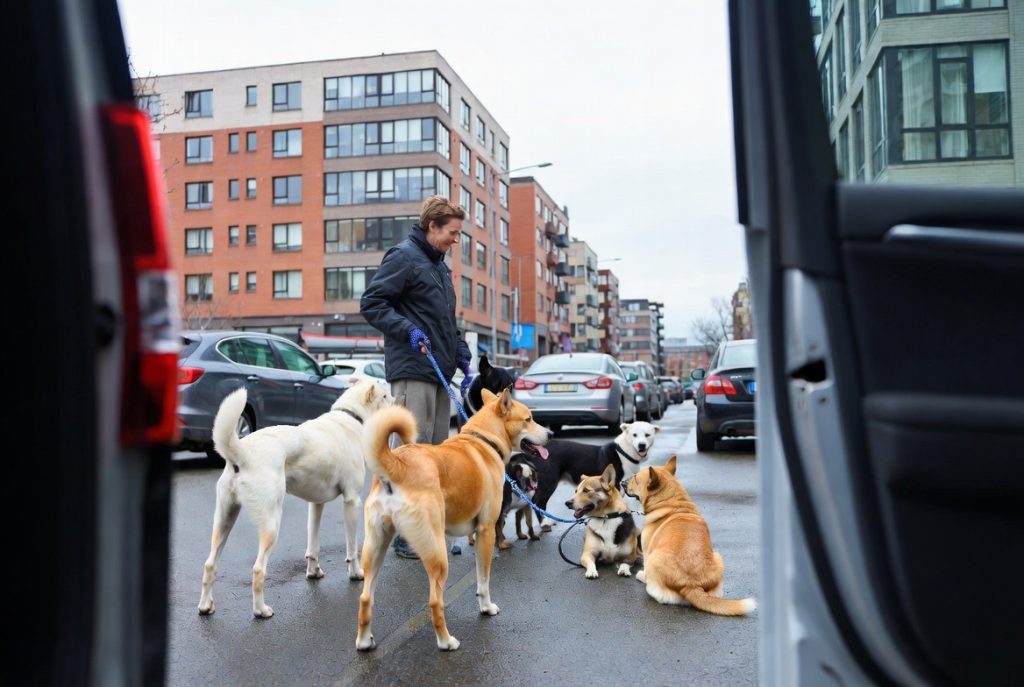
A dog-walker incident on a city street is a strange three-way liability puzzle: driver, walker, owner. Each one carries some, and none carry all. When a dog lunges into traffic and a car swerves into a parked van, figuring out who owes what — and to whom — is less obvious than it looks.
City driving means sharing the road with a lot of things that aren’t cars. Dogs are near the top of that list. Understanding where your auto policy ends and someone else’s coverage begins isn’t paranoia. It’s just practical.
Auto vs. Homeowners vs. Business Coverage
Your auto liability covers bodily injury and property damage you cause with your vehicle. If a dog darts into the street and you brake hard but still clip the walker, your auto policy is likely first in line for the walker’s injuries. Your insurer investigates; the claimant gets paid; your rate potentially adjusts.
The dog owner is a different story. Most homeowners and renters policies include personal liability coverage — typically $100,000 to $300,000 — for injuries their dog causes away from the home. So if the dog is what started the chain reaction, the owner’s renters policy may actually be the one writing the check.
The walker sitting in the middle of this? If they’re a professional dog walker operating a business — even a solo, app-based one — they’re supposed to carry a commercial general liability policy specifically for this scenario. Most do. Many don’t. The professional ones who carry it are easy to identify; they’ll have proof of coverage. The weekend-gig walkers are the wildcard.
The Off-Lead Wrinkle
Leash laws exist in every major U.S. city. Violation shifts liability decisively. An off-lead dog that causes an accident puts the walker — and potentially the owner — on the hook for contributory negligence, even if the driver did nothing wrong.
That matters for your claim if you’re the driver. Documenting that the dog was off-lead at the time of an incident (dashcam footage, witness statements, a police report) can shift the proportional liability away from you in a modified comparative fault state. Most urban states are exactly that.
What it doesn’t do: protect you from a counter-claim if your speed, distraction, or lane position contributed to the severity. City driving is rarely clean. Even a technically “not your fault” accident can result in a shared-fault finding if you were going 28 in a 20.
Why Claim Severity Tends to Be Low
Here’s the underappreciated part: dog-related traffic incidents, even the dramatic ones, tend to produce relatively modest insurance claims. The dog is usually not seriously injured by a car — dogs are fast. Walkers fall, but rarely get hit. Drivers swerve, but typically at low city speeds.
What does accumulate: property damage. A hard swerve into a parked car at 20 mph is a $4,000 to $8,000 claim before anyone checks who’s at fault. Deductibles apply. Subrogation starts. You spend six months getting letters about a three-second incident.
Keep your liability limits adequate for urban density. A $50,000 property damage limit feels comfortable until one incident involves two parked vehicles on a narrow street.
A Short Street-Edge Habit
The practical adjustment is behavioral, not just financial. Slow to 15 mph when you see a dog walker on the street — not because the law demands it, but because a dog’s reaction time is roughly zero and yours is roughly half a second. Dashcam on, always. Know your deductible before something happens, not after.
And if you’re ever the walker in this equation? Your renters policy may cover you as a private dog-sitter. The moment you take money for it — even Venmo from a friend — it’s a business activity and you’re likely uncovered by a personal policy. Act accordingly.
What to do this week: Pull up your auto declarations page and confirm your property damage liability limit — if it’s under $100,000 in a dense urban area, call your agent. Compare coverage options that actually fit how you drive →
Last modified: March 24, 2026
About the Author: Jordan Lee