
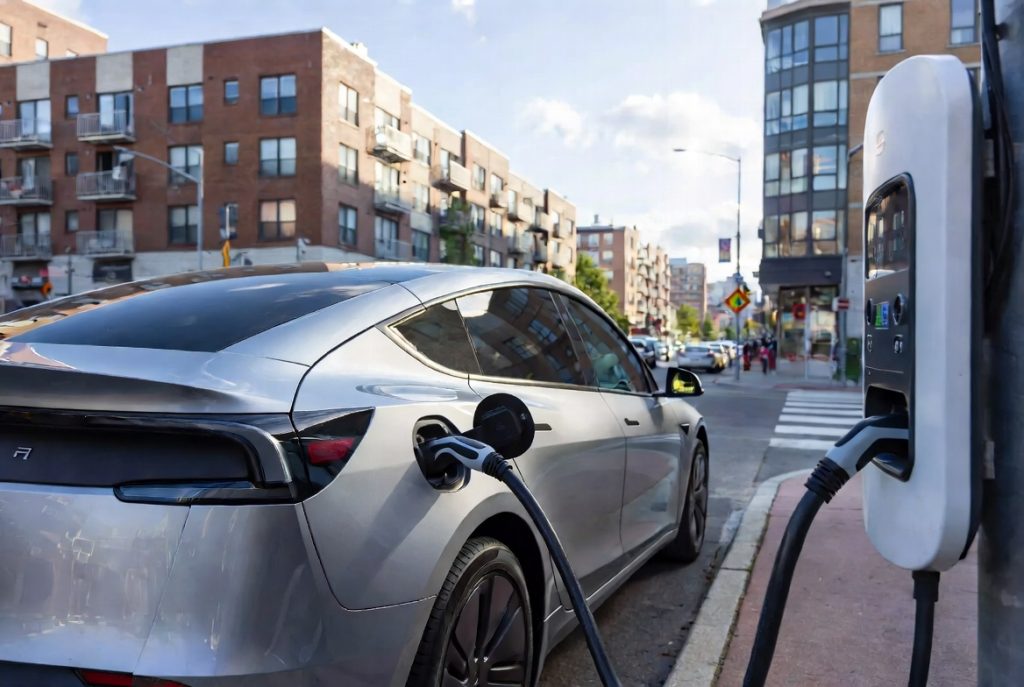
The “no ICEing” rules are mostly social, but the insurance stories around public charging stations are real — and most of them have nothing to do with the charger and everything to do with what’s parked next to it. Charging stalls concentrate vehicles in tight spaces for extended periods. The math on parking incidents goes up accordingly.
The Three Insurance Scenarios at a Charging Stall
When something goes wrong at a charging station, it almost always falls into one of three buckets — and each one traces to a different insurance policy:
- Your car gets hit while charging. Another vehicle clips you pulling in or out. This is a standard parking-lot collision — the at-fault driver’s liability coverage pays for your damage. If they leave, it becomes an uninsured motorist property damage claim or a collision claim on your policy, depending on your state and coverage.
- The charging equipment damages your car. A charger cable that snaps back, a malfunctioning connector that scores your charging port, a charge-unit cabinet that falls. In these cases, the charging network (ChargePoint, Blink, Electrify America) may bear liability — but their terms of service typically disclaim it broadly. You’ll file on your comprehensive first and let your carrier pursue subrogation.
- Your cable gets stolen. Charging cable theft is real, particularly with Level 2 home-portable cables left in vehicles. This is a comprehensive claim — theft of a vehicle component. Replacement cables for some EVs run $400–$600.
When the Charger Is the Problem
Charging network liability disclaimers are aggressive. ChargePoint’s terms, for example, disclaim responsibility for “any damage to your vehicle arising from use of the charging services.” That language is standard across the major networks. It may not hold up in every jurisdiction — a charger malfunction that demonstrably causes electrical damage to a vehicle is a products liability argument worth having — but “the charger broke my car, the network will pay” is not the fast path.
The practical move: file on your comprehensive coverage immediately, document the charger’s malfunction (photos of the unit, error codes on the screen, a note of the station ID and connector number), and let your carrier’s subrogation team pursue the network afterward. You get paid faster. Your carrier handles the legal conversation.
One specific scenario worth knowing: if a ground-fault interruption (GFCI trip) during charging causes an incomplete charge cycle or, in rare cases, some electrical interaction with your vehicle’s charging system, the incident log from the charging network is critical documentation. You can request it. Some networks provide it automatically; others require a formal request citing your account and session ID.
When the Parked Car Next to You Is the Problem
Charging stalls are narrow. Many are designed for standard sedans and regularly occupied by larger vehicles. The combination of tight geometry, drivers who park and leave for 30–45 minutes, and high turnover creates a door-ding and bumper-clip environment.
Hit-while-parked at a charging stall follows the same rules as any parking lot incident: if there’s a responsible party with identifiable insurance, their liability coverage applies. If they’re gone, you’re into UMPD (uninsured motorist property damage) territory in states that offer it, or collision coverage with your deductible applying.
Some charging locations — particularly those in parking structures — have surveillance cameras that capture stall activity. The charging network or garage operator may have footage. Get the station manager’s contact information and request preservation of footage within 24 hours of the incident. After 48–72 hours, many systems overwrite.
A Short Charging-Stall Etiquette Code
Because this is, after all, still a community:
- Move your car when charging is complete. Charge-complete hold-ups are not an insurance issue, but they’re the kind of bad-faith that makes the EV community look bad to everyone else in the lot.
- Don’t leave your portable cable unattended in a public space unless it’s locked to the vehicle.
- If you clip someone’s car — at a charger or anywhere else — leave a note. The surveillance cameras at DC fast chargers are better than you think.
- Photograph the charger unit number and your connection before you walk away. It takes 10 seconds and creates documentation if anything goes wrong during the session.
What to do this week: Check your comprehensive deductible — if it’s above $1,000, consider whether lowering it makes sense given that charging-related incidents often land in that coverage bucket. Compare coverage options that actually fit how you drive →
Last modified: January 10, 2026
About the Author: Jordan Lee