
Your car gets broken into. The window is on you. The gear inside the car? That’s where it gets interesting. Most people assume their auto insurance covers everything in the vehicle. It doesn’t. Auto policies cover the vehicle. Personal property inside the vehicle is a separate conversation, and the answer depends on coverage you may or may not have somewhere else.
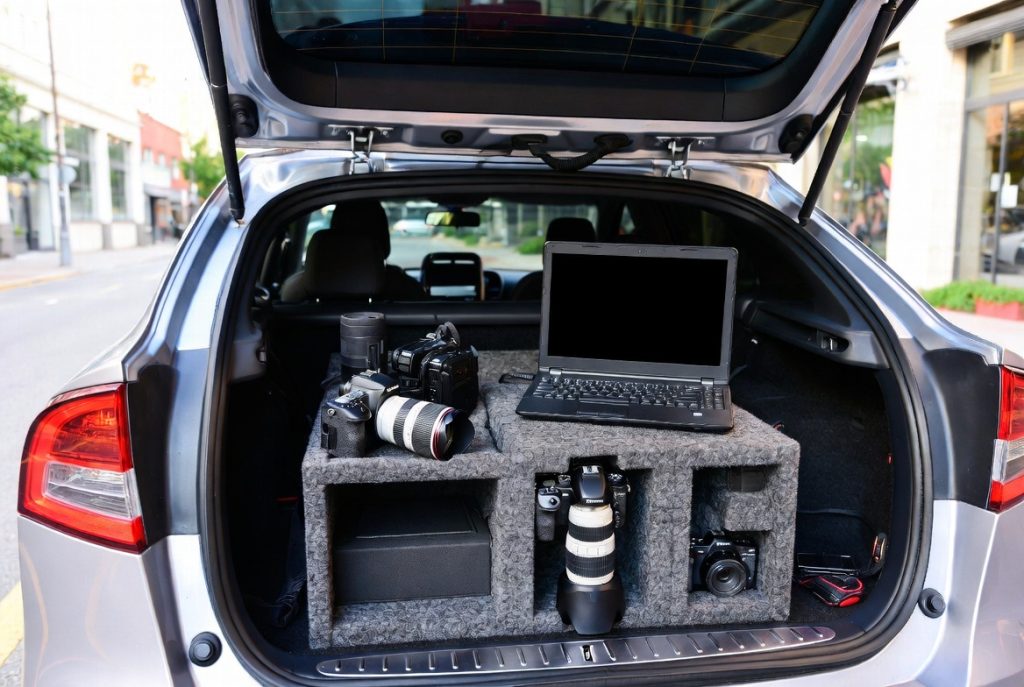
For freelancers who carry equipment — cameras, laptops, audio gear, lighting rigs — this isn’t an abstract question. It’s a real financial exposure that needs a real answer.
Why Auto Policies Don’t Pay for the Gear
Auto comprehensive coverage exists to pay for damage to the vehicle from non-collision events: theft, vandalism, weather, falling objects. The policy is written around the car as the insured item. Personal property is explicitly excluded from most auto policies because it’s meant to be covered elsewhere — under renters or homeowners insurance.
When your car is broken into and your camera bag disappears, the auto claim pays to replace the window. It stops there. The camera, the lenses, the bag itself — those go through a different claim, a different policy, and potentially a different deductible.
If you don’t have renters or homeowners insurance, the gear is uninsured. The loss is yours.
Renters and Homeowners Off-Premises Clauses
The mechanism that covers your gear in the car is the off-premises personal property provision in your renters or homeowners policy. Standard policies cover your personal property up to a specified limit. The off-premises clause extends that coverage to items that are temporarily away from your residence — in your car, in a hotel room, at a client’s space.
The standard limit for off-premises coverage is 10% of your total personal property coverage. If you carry $40,000 in personal property coverage, your off-premises limit is $4,000. For some freelancers, that’s sufficient. For someone with a professional camera body, two lenses, a drone, and a laptop in the back seat, it falls short fast.
You can increase the off-premises limit. Ask your renters insurer specifically — it’s not always obvious that this is adjustable, but it usually is.
Scheduling vs. Blanket Coverage
There are two ways to insure specific high-value items: scheduled personal property and blanket coverage.
Scheduled coverage means you list individual items by name, serial number, and appraised value. Each item gets its own coverage limit. The advantages: you get replacement-cost coverage at the specific item value, there’s typically no deductible on a scheduled item claim, and the perils covered are broader — accidental damage is often included, which standard renters coverage doesn’t cover.
The cost for scheduling a $2,500 camera body and a $1,200 lens is usually $30–$70 per year total. For the coverage it provides, this is an unusually good deal.
Blanket coverage sets a single limit for a category of items — “all electronics up to $8,000,” for example. It’s simpler to manage and doesn’t require itemizing every piece of gear. It’s useful when you have a lot of lower-value items rather than a few high-value ones. The deductible usually applies, and accidental damage coverage varies.
For freelancers with specific expensive items — a mirrorless camera, a specialized audio interface, a laptop configured for professional work — scheduled coverage is almost always the right answer. For someone with a general collection of mid-range gear that’s hard to itemize, blanket coverage with a high enough limit works.
A 10-Minute Inventory Routine
Before you can cover your gear properly, you need to know what you have and what it’s worth. This sounds obvious. Most people haven’t done it.
Set a 10-minute timer. Walk through your workspace and your car. List every piece of equipment with a replacement value above $200. Note the model and, if you have it, the serial number. Take a photo of each item with the serial number visible. Store the list somewhere that isn’t the car — cloud storage, email it to yourself, anything off-device.
This inventory serves two purposes: it tells you how much coverage you actually need, and it gives you the documentation to support a claim quickly if you need one. Claims with serial numbers and photos resolve faster and with less friction than claims without them.
Once the inventory exists, the insurance call is simple: here’s my list, here are the values, what does it cost to schedule these items? Most carriers can add scheduled items in one phone call or through an online portal. It’s a 20-minute task that closes one of the most common coverage gaps freelancers carry without knowing it.
What to do this week: Do the 10-minute gear inventory, then call your renters insurer and ask for a scheduled personal property quote on your two most expensive items. Compare coverage options that actually fit how you drive →
Last modified: May 7, 2026
About the Author: Jordan Lee