

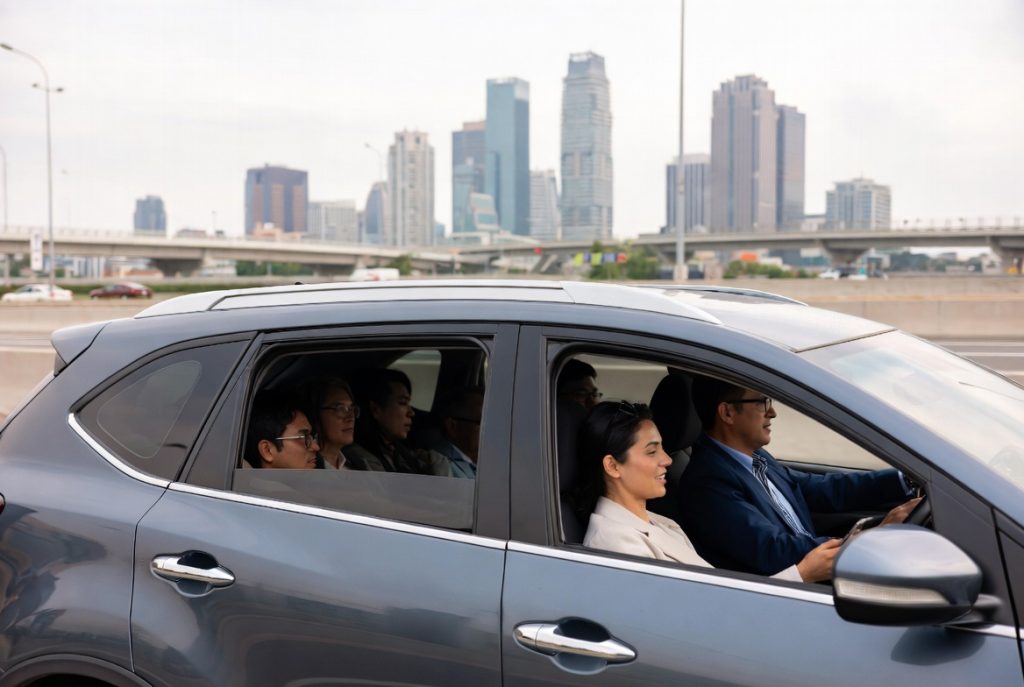
Driving the same three coworkers to work twice a week sits awkwardly between personal and commercial coverage. Most personal auto policies are silent on casual carpooling — which means you’re probably fine, until you aren’t. The line carriers draw is usually about money changing hands, and it’s worth understanding before you formalize the arrangement.
What Counts as Carpooling, Plainly
Casual carpooling — picking up coworkers or friends, rotating who drives, no fees exchanged — is generally covered under standard personal auto policies. You’re still using the vehicle for personal transportation; you’ve just brought people along. Courts and carriers have consistently treated this as incidental personal use, not commercial activity.
The key word is “incidental.” If you’re driving the same passengers to the same destination on a regular, scheduled basis, some carriers interpret this as a regular transportation service even without fees. The threshold isn’t crisp, but occasional carpooling reads very differently than a structured weekday arrangement to most underwriters.
“Slug lines” — the informal hitchhiking networks in cities like Washington DC and San Francisco where strangers queue at designated points for rides toward their commute destination — are legally murky. Drivers typically don’t collect payment, and from a coverage standpoint the dynamic looks like casual carpooling. But the passengers are strangers, the pickup is systematic, and the line between that and a rideshare is blurry enough to be worth a quick call to your carrier before participating regularly.
When Money Changes Hands
This is where coverage gaps become real. If your passengers pay you — even informally, even just their share of gas — many personal auto policies consider that a for-hire arrangement. The policy language usually excludes coverage “when the vehicle is used to carry passengers for a charge.” Gas-share is sometimes interpretable as a “charge” depending on the policy wording and the jurisdiction.
The practical risk isn’t that your carrier denies routine coverage. It’s that if you’re in an accident while running a fee-based carpool and a passenger is injured, the carrier may argue the arrangement was a commercial use excluded from your personal policy. That argument, if successful, leaves you personally liable for a claim your policy won’t pay.
Some states have carpool exception provisions that protect drivers who collect only a proportional share of actual costs — no profit. California has one of the more developed versions of this. But “only my share of gas” is a claim you’d need to document if it were ever contested. Keep records if money changes hands, even trivially.
Vanpool Programs and Their Coverage Layers
Employer-sponsored vanpool programs are different from informal carpools. Most operate under commercial auto policies either held by the employer or by a third-party vanpool operator (Enterprise Rideshare, Commute with Enterprise, Scoop, and similar programs). If you drive a company-sponsored vanpool van, you’re typically operating under that commercial policy, not your personal one.
The coverage question for vanpool participants is: what happens to your personal auto policy if you’re in an accident while operating the vanpool vehicle? Most personal policies exclude coverage for non-owned vehicles used in commercial arrangements. The employer’s or program’s commercial policy is the primary coverage. Confirming those policy limits before you volunteer to be the regular driver is worth doing — ask the HR or benefits contact who manages the program.
If you’re driving your personal vehicle for a formally registered vanpool program, the coverage landscape is less clear and highly carrier-specific. Some programs provide supplemental commercial liability for registered drivers. Others don’t. Get this in writing before you start.
A Clean Disclosure to Your Carrier
The cleanest approach is to call your carrier, describe the arrangement specifically — how often, how many passengers, whether any money changes hands — and ask whether your current policy covers it. This takes under 10 minutes. If your carrier says your personal policy doesn’t extend to the arrangement, ask whether they can add a rider or endorsement. Some carriers offer carpool-specific endorsements at minimal cost.
The alternative is assuming coverage applies and learning otherwise during a claim — which is a significantly worse conversation to have.
What to do this week: Call your carrier and describe your commute arrangement specifically; confirm in writing that your policy covers the scenario before the next carpool run. Compare coverage options that actually fit how you drive →
Last modified: March 10, 2026
About the Author: Jordan Lee