
Municipalities almost never pay for street-sweeper damage to parked cars. You’ll hear otherwise from frustrated neighbors, but the legal reality is that cities enjoy significant immunity from routine operational claims. Your comprehensive coverage usually steps in. The question that most car owners skip — until they’re standing next to a scraped quarter-panel — is how to file effectively before the body shops back up with identical claims.
The Municipal Liability Question
Street sweepers are city equipment operated by city employees performing a public service. In most states, municipalities are protected by sovereign immunity for discretionary governmental functions — meaning they’re shielded from lawsuits for operational decisions like sweeping routes, equipment maintenance schedules, and brush pressure settings.
There are exceptions. If the city was demonstrably negligent — a sweeper operating with a known defective brush, for example, or one that veered outside its designated path — a tort claim against the city can sometimes succeed. The standard is high. “The truck was going too fast” is not usually enough. Documentation of a known defect or an obvious deviation from standard practice is what moves a city claim forward.
Filing a formal notice of claim with the city is the first step if you believe municipal negligence is in play. Most cities require this notice within 90 days of the incident — and in some cases 30 days — or you waive the right to sue. The deadline is unforgiving. If you’re going to pursue it, act quickly.
Comp Coverage Scope
Comprehensive coverage on your auto policy covers damage from causes other than collision — including contact from objects, equipment, and infrastructure. A street sweeper brush dragging across your vehicle’s panels qualifies. So does a sweeper-thrown rock or debris that impacts the car.
The deductible applies. If your comp deductible is $500 and the damage is $600, the math barely pencils out — and filing a comp claim on a borderline amount can affect future premiums depending on your carrier and state. Get an estimate first. For minor paint transfer and light scratching, detailing and touch-up may be more efficient than a formal claim.
For significant panel damage — deep scratches, gouges, or dents from sweeper contact — filing is straightforward. Document the damage thoroughly before moving the car. Photographs from multiple angles, close-ups of the contact pattern, and a wide shot showing your parking position relative to the sweeping lane all help your claim.
Filing a Claim Against the City — When It Works
City claims that succeed generally share a few features: documented evidence of the specific sweeper that caused the damage (driver ID, route, time), a witness or camera footage, and evidence of equipment malfunction rather than normal operation. If you have a neighbor’s doorbell camera that captured the incident, secure that footage immediately — it’s the most persuasive documentation type.
Submit your notice of claim to the city’s legal or claims department — not the sanitation department. Most cities have an online portal. Attach your photographs, damage estimate from a licensed shop, and any camera footage. Then expect a long wait. Cities process these claims slowly, and the response is often a denial regardless of merit, because cities know that most claimants won’t pursue litigation over a few hundred dollars.
Small claims court is a realistic option if the city denies and the damage amount falls within your state’s small claims limit (typically $5,000–$10,000). Arriving with documentation and an estimate tends to fare reasonably well with judges who understand municipal immunity limits.
A 10-Minute Prevention Routine
Street sweeping schedules are public record and almost universally available in city apps or online lookup tools by address. Most major cities — New York, Chicago, LA, SF — have apps that show your block’s exact sweeping windows. Setting a phone reminder 15 minutes before the sweeper arrives on your block costs nothing.
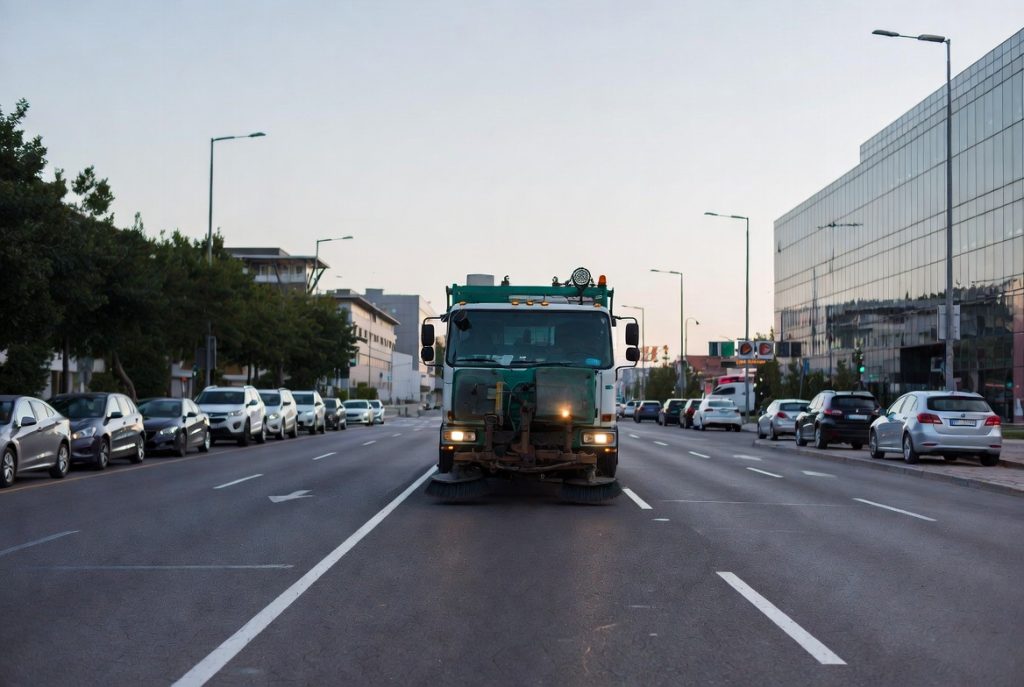
If moving the car isn’t feasible, parking tight to the curb and slightly forward of the marked zone boundary reduces brush-contact probability. The sweeper’s left-side brush arc has a predictable radius — cars parked far from the curb are more exposed than those tight to it.
What to do this week: Look up your block’s street sweeping schedule in your city’s app and set a recurring phone reminder for each cleaning window. Compare coverage options that actually fit how you drive →
Last modified: March 6, 2026
About the Author: Jordan Lee